
City to City Chauffeur in Europe: When Driving Beats Flying
A city to city chauffeur often beats a short-haul flight door to door. Honest route times from Amsterdam, what drives the cost, and where flying still wins.
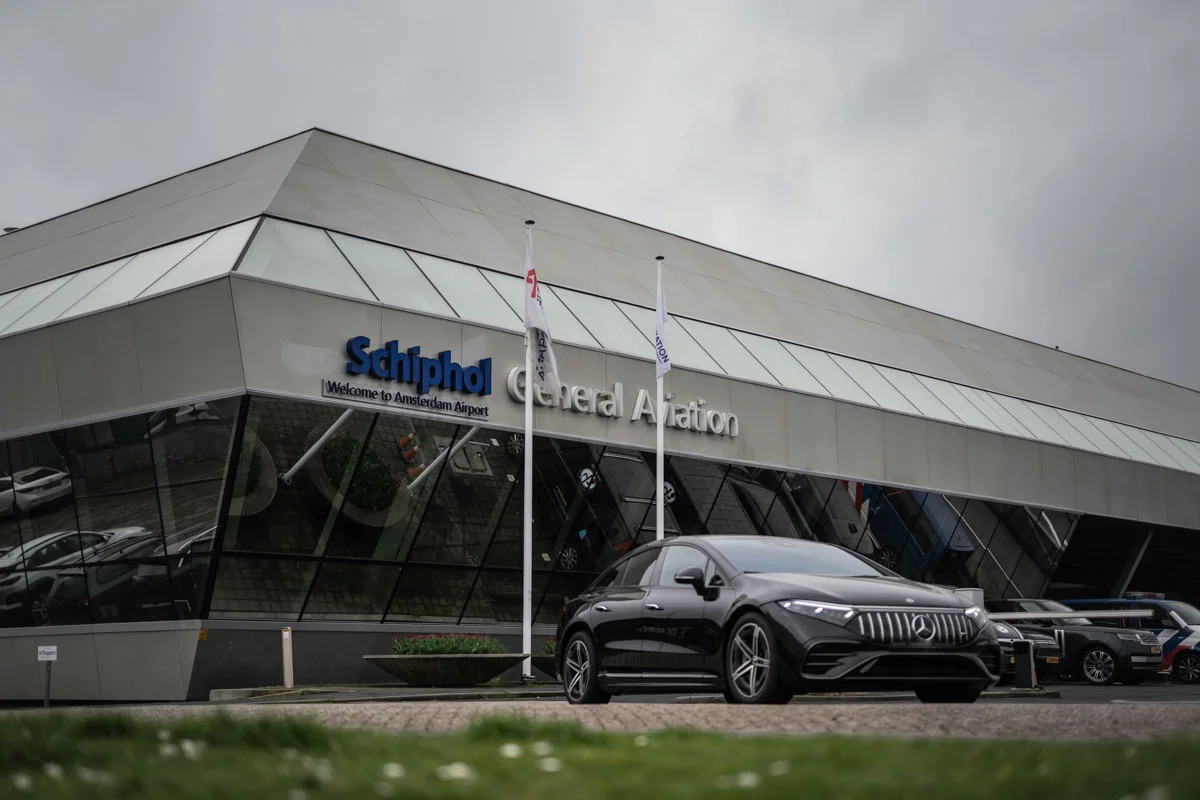
A city to city chauffeur collects you at one address and delivers you to another, in a different city or country, in a single uninterrupted drive. On European routes under about 500 kilometres it often beats a short-haul flight door to door, and on longer ones it wins on how you use the hours. Beyond roughly 700 kilometres, fly.
Airline timetables hide this because they only count the flight. The hour in the air between Amsterdam and Munich says nothing about the two hours before it or the hour after. This guide does the sums properly, route by route. It sets the car against the train as well as the plane, and it is straight about where the car loses. The times below are the ones we plan with from Amsterdam.
What Is a City-to-City Chauffeur?
A city-to-city chauffeur is a private driver and vehicle booked for a journey between two cities, starting at your door and ending at your destination’s door. It differs from a taxi in two ways that matter over distance: the price is agreed before departure, and the same professional chauffeur drives the whole way.
Most bookings take one of three shapes:
- One way. Amsterdam to Brussels, drop-off at the hotel, done. You make your own way back or book the return separately.
- Day hire. The car takes you there, waits through the meetings and brings you home. This is the shape for a same-day return.
- Multi-day itinerary. Several cities over several days with the same chauffeur and car throughout. Our long-distance car service guide covers how those trips are structured around driving hours and overnight stops.
The Honest Maths of a One-Hour Flight
A one-hour European flight costs four to five and a half hours door to door. Count every segment of a typical short-haul business trip:
- Travel from your home or office to the airport: 30 to 60 minutes
- The margin most travellers build in before a European departure, for bag drop and security: 90 to 120 minutes
- The flight itself: about 60 minutes
- Disembarking, walking the terminal, waiting at the baggage belt: 30 to 45 minutes
- Transfer from the destination airport into the city: 30 to 60 minutes
That total assumes everything runs to plan. A late inbound aircraft or a long security queue is not an edge case on short-haul; it is a routine risk you carry on every trip.
A chauffeur removes every one of those segments except the driving. There is no check-in, no security lane, no boarding group, no baggage belt and no onward transfer, because the vehicle starts at your door and finishes at the other one.
Chauffeur or Plane: Door-to-Door Times From Amsterdam
Under roughly three hours of driving, the car is simply faster door to door. Between three and five hours, it is a draw on time and the car wins on everything else. Beyond that, flying takes the time argument back.
| Route | Chauffeur, door to door | Flying, door to door (realistic) | Verdict |
|---|---|---|---|
| Amsterdam to Antwerp | About 2 hours | No sensible flight | Road |
| Amsterdam to Brussels | 2 to 2.5 hours | 4 to 5 hours, where a flight is offered at all | Road, clearly |
| Amsterdam to Düsseldorf | About 2 hours 15 minutes | 3.5 to 4 hours | Road |
| Amsterdam to Frankfurt | About 4.5 hours | About 4 hours | Close: road wins on usable time |
| Amsterdam to Paris | 5 to 5.5 hours | About 5 hours | Even: road for two or more travellers |
| Amsterdam to London | 7 to 8.5 hours via the Channel Tunnel | About 5 hours | Air or Eurostar, unless luggage or a group decides it |
| Amsterdam to Munich | About 8 hours with breaks | 4.5 to 5.5 hours | Air, unless working en route matters most |
Road times assume normal traffic and sensible breaks on the longer legs. Rush hour around Antwerp, Brussels and the Paris ring road is the main variable, which is why departure times are planned backwards from when you need to arrive. Some clients still choose an eight-hour drive over a flight to Munich, because those eight hours belong entirely to them.
Chauffeur vs Train: Where Rail Is the Real Competitor
On several of these corridors the honest competitor is not the plane but the high-speed train. The direct service from Amsterdam to Paris Gare du Nord is the fastest way between the two city centres, and the ICE to Düsseldorf and Frankfurt is quick and comfortable. For a solo traveller with a cabin bag, going centre to centre, the train is usually the right choice, and we say so.
The picture changes when the journey is not centre to centre. Add the transfer to Amsterdam Centraal, the boarding margin and the taxi at the other end, and Paris by train comes out at roughly 4.5 to 5 hours door to door, close to the car. The train also loses ground fast with:
- Groups. One Mercedes V-Class seats seven with luggage; seven train tickets bought late do not compare well.
- Luggage. On the train you carry it up stairs and along platforms. In the car it goes in the boot at your door and comes out at your destination.
- Addresses outside the centre. A trade fair, a factory, a country hotel or a private airfield is rarely next to a main station.
- Privacy. A full carriage is not the place for a confidential call.
The Hours You Get Back Are Not Equal Hours
Even where the totals are level, the quality of the time is not. Air travel breaks your day into short segments (queue, wait, board, taxi, climb, descend), none long enough for real work, most of them spent standing.
A long distance chauffeur journey is one continuous block. The rear cabin of an S-Class is a private office: calls stay confidential because nobody else is in the vehicle, the laptop stays open from the first kilometre to the last, and you can sleep without a stranger’s elbow in your ribs. Three productive hours to Brussels are worth more than five fragmented ones through two airports.
You also arrive having finished the preparation rather than having queued for it. Outbound, two hours fits a full briefing cycle; on the way back, it fits the debrief while the day is still fresh. Clients who switch to road travel on the Brussels or Düsseldorf corridors rarely switch back.
Luggage, Stops and Changes of Plan
The car adapts to the day; a flight or a train seat does not. That flexibility is the part of city-to-city travel that never shows up in a timetable comparison.
Luggage That Never Leaves Your Custody
On a flight, your luggage leaves your hands at bag drop and rejoins you, usually, at a belt after landing. In a chauffeured car it is never weighed, never gate-checked and never out of sight of the person responsible for it. For anyone travelling with samples, equipment, garment bags or simply more than a cabin case, this alone can settle the question.
Stops Along the Way
A city-to-city chauffeur can stop wherever the route allows: lunch in Antwerp on the way to Paris, a site visit outside Utrecht on the way to Germany, a second meeting in Cologne after a fair day in Düsseldorf (the two cities are about 40 minutes apart). Tell us the stops at booking and the plan and the quote both account for them.
When the Meeting Overruns
A booked flight or train departs whether you have finished or not. On a day booking, the chauffeur waits and the return simply moves. Our booking terms set out how waiting beyond the agreed schedule is charged, so an overrun is a known quantity rather than a negotiation at the kerb.
Crossing Borders by Car in Europe
Within the Schengen area, checks at internal borders have been abolished, so a chauffeured car crosses from the Netherlands into Belgium, Germany, France or Luxembourg without stopping. For planning purposes, the border adds no time to the journey.
Two caveats are worth knowing. Schengen countries may temporarily reintroduce internal border controls, and spot checks do happen, so every passenger should carry a passport or national ID card. And the United Kingdom sits outside Schengen: Amsterdam to London by road involves the Channel Tunnel or a ferry and a full border check. Our guide to chauffeur service in Europe across borders covers the cross-border detail country by country.
What Does a City-to-City Chauffeur Cost?
The cost of a city-to-city chauffeur depends on distance, total duration (including any waiting) and vehicle class, so any honest answer is a quote rather than a rate card. What matters more than the number is how it is set.
- The fare is agreed at booking. SilverDrive quotes before the car moves, with no hidden fees and no surge multipliers. A busy trade-fair week does not change a price you have already agreed.
- Some costs sit outside the quote. Our booking terms exclude parking, tolls, ferry and tunnel costs. On multi-day itineraries the chauffeur’s meals and overnight accommodation are also listed separately. We would rather tell you now than surprise you on the invoice.
- The economics improve with every passenger. One person on a cheap advance fare will usually pay less to fly or take the train. Two or three colleagues sharing one car, booked at short notice, is a different comparison, and often a close one.
We hold a firm view on this: a price should be agreed before the car moves. Meter anxiety and surge pricing are exactly what a pre-booked chauffeur exists to remove.
When Flying Still Wins
The car does not win everything, and it serves nobody to pretend otherwise.
- Distance. Beyond roughly 700 kilometres (Amsterdam to Milan, Madrid or Vienna), flying is faster door to door and the gap grows with every kilometre. A flight for the long stretch with a chauffeur at each end is often the smarter plan.
- Solo travellers on a budget. A single passenger with a cabin bag and an advance fare will rarely find the car cheaper.
- Long same-day returns. If you must be in Munich by morning and home by night, the aircraft is the only honest answer. Professional driving hours are regulated, and a serious operator plans inside those limits rather than around them.
What the car offers on every route is certainty over the parts you can control: an agreed fare, a vehicle that leaves when you are ready, and a plan that bends when your day does.
How SilverDrive Runs City-to-City Journeys
SilverDrive was founded in Amsterdam and runs city-to-city chauffeur rides across Europe with its own fleet, not as a broker reselling your journey to whichever subcontractor is free. That matters on a long drive: the operator who owns the car is accountable for its condition, and one chauffeur accountable from door to door beats a chain of handovers.
Chauffeurs are licensed, background checked and English speaking, and on multi-day itineraries the same chauffeur stays with you throughout. Vehicle choice follows the journey:
- One to three passengers: the Mercedes-Benz S-Class, the electric BMW i7 or Mercedes EQS, or the Mercedes-Maybach for the most comfortable way to cross a continent by road.
- Four to seven passengers: the Mercedes V-Class seats seven with full luggage; the EQV with massage seats takes five or six.
- Larger groups: the Mercedes Sprinter or the Setra coach.
Repeat clients are the best measure of whether long drives work. “As always a reliable and comfortable drive,” as a Trustpilot reviewer put it in June 2025, and SilverDrive holds a TrustScore of 4.7 from 34 reviews on Trustpilot (checked November 2026).
Frequently Asked Questions
Is a chauffeur faster than flying between European cities?
Door to door, often yes on routes under about 500 kilometres. A one-hour flight usually takes four to five hours once you add the airport transfer, the security margin, boarding and the onward journey. Amsterdam to Brussels, Antwerp or Düsseldorf is quicker by road. Beyond roughly 700 kilometres, flying generally wins on time.
How much does a city to city chauffeur cost?
It depends on distance, duration and vehicle class, so there is no fixed rate per kilometre to quote here. SilverDrive agrees the fare at booking, with no surge multipliers and no hidden fees. Parking, tolls, ferry and tunnel costs sit outside the quote. For two or more travellers, one car often compares well with flexible air or rail fares.
Can the chauffeur make stops along the way?
Yes. A lunch, a site visit or a meeting in a city on the route is part of the plan rather than a detour. Tell us the stops when you book so the timing and the quote reflect them. Amsterdam to Paris, for example, runs close to Antwerp and Brussels, so a midday meeting there costs little extra time.
Can I do a same-day return by chauffeur?
Yes, on routes up to about two and a half to three hours each way, such as Amsterdam to Brussels, Antwerp, Düsseldorf or Cologne. Book the day rather than two transfers and the car waits while you meet. Beyond that distance, driving hours make an overnight stop or a flight for one leg the honest answer.
Do I need a passport for a chauffeur journey across borders in Europe?
Carry a passport or national ID card. Within the Schengen area there are no routine checks at internal borders, so the car crosses from the Netherlands into Belgium, Germany or France without stopping. Countries can reintroduce temporary checks, though, and spot checks do happen.
Can I work during a city-to-city chauffeur journey?
Yes, and this is the strongest argument for the car. The rear of an S-Class or V-Class is a private workspace with no boarding calls and no strangers alongside. A three-hour drive can be three hours of calls and preparation; the same trip by air breaks into short segments too brief for real work.
Do the Sums for Your Own Route
Count every segment of your usual short-haul trip (both airport transfers, the queues, the buffer you build in for things going wrong) and set it against one drive from door to door. On most routes out of the Netherlands under 500 kilometres, a city to city chauffeur wins on time; on the rest, it wins on what you do with the time. Send us your route, your dates and the number of travellers, and we will quote a fare you can set against the flight. Book your city-to-city chauffeur.
More from the Journal

Barcelona Car Service: BCN Airport, Cruise Port and City
Barcelona car service explained: BCN airport pickups, cruise port transfers at Moll Adossat, city hours and day trips, and how to book a car with driver well.
Private Chauffeur: What It Is, What It Costs, How to Choose
A private chauffeur explained: the four ways to book one, what actually sets the price, the brief to send and how to choose an operator anywhere in Europe.

Places That Pay You to Move There: What Is Real in 2026
Places that pay you to move there in 2026, checked against official sources: Irish islands, Sardinia, Sicily, rural Spain, Tulsa and West Virginia.