
Mercedes V-Class Chauffeur Service: The Right Car for Three or More
When a Mercedes V-Class beats two saloons: seating layouts, luggage, car-park height limits, the electric EQV, and what to check before booking.
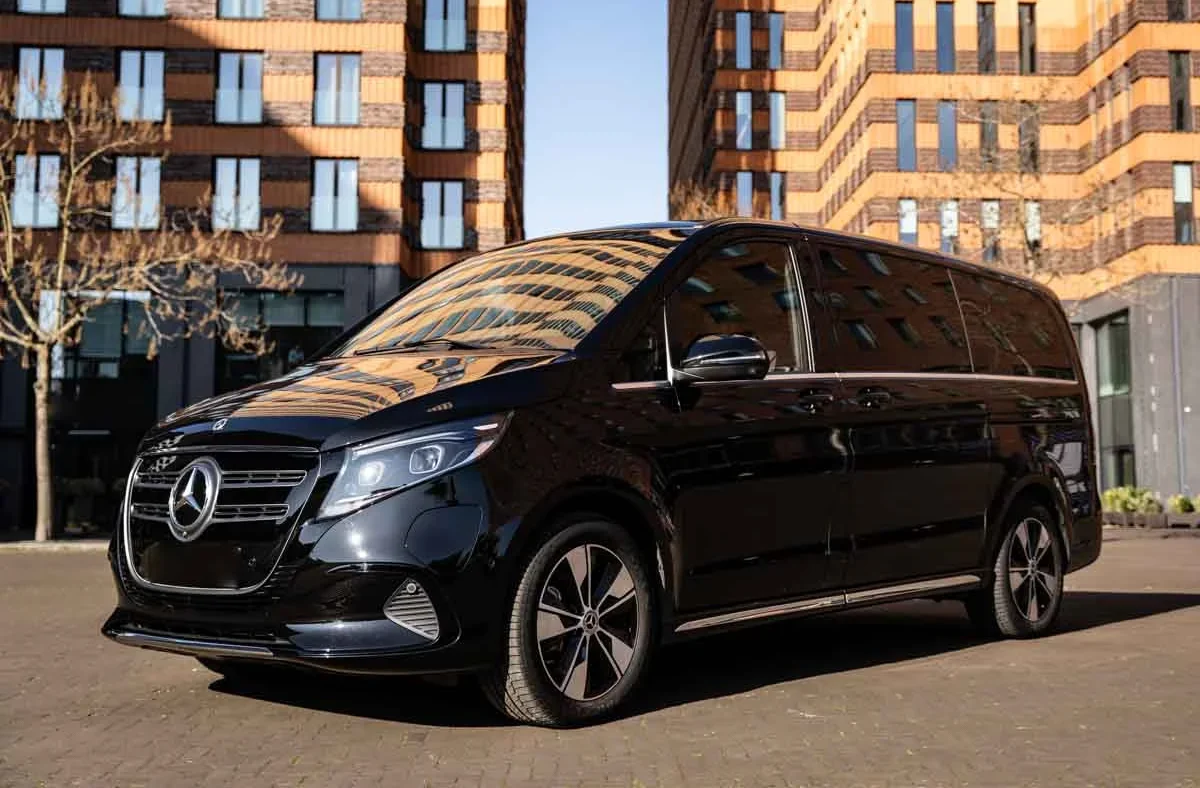
The Mercedes V-Class is the least glamorous vehicle in most chauffeur fleets and, for a large share of real bookings, the correct one. The moment a group passes two passengers, or two passengers pass four suitcases, the executive saloon stops being the premium option and starts being the impractical one.
This is a guide to when the V-Class is the right booking, what the layouts actually mean, and the one physical constraint that catches people out.
The Arithmetic That Decides It
Three passengers can technically fit across the rear bench of an S-Class. Nobody enjoys it, and with a chauffeur-package interior the middle seat is not really there.
So the practical thresholds are these:
| Passengers | Luggage | Sensible vehicle |
|---|---|---|
| 1 to 2 | Cabin bags | E-Class or S-Class |
| 1 to 2 | Two or more large cases | S-Class, or V-Class if cases are oversized |
| 3 to 4 | Any real luggage | V-Class |
| 5 to 7 | Any | V-Class |
| 8+ | Any | Minibus or coach |
The instinct when a group grows is to book two saloons. It is usually the wrong call. Two cars means two drivers, two positioning runs, two arrival times, and a group that spends the journey in two separate conversations. It costs more and delivers less.
Layouts: The Part Worth Specifying
“V-Class” describes a body, not an interior. The seating configuration makes a large difference to the experience, and it is the thing most people forget to specify.
Standard forward-facing rows. Six or seven seats, all facing forward. Maximum capacity, straightforward, right for airport runs and group transfers where the journey is transit rather than time.
Conference or vis-à-vis layout. Two pairs of seats facing each other, usually with a table between them. This turns the vehicle into a meeting room that happens to be moving, and it is the reason a great deal of corporate V-Class work exists. Capacity drops, usefulness rises sharply.
Reduced-seat executive layouts. Four or five individual seats with generous space between them, occupying the middle ground.
If your group is travelling from Schiphol to a meeting and intends to prepare on the way, ask for a conference layout. If seven people simply need to reach the same venue, do not: you will lose seats for a table nobody uses.
The Height Problem Nobody Mentions
Here is the practical constraint that turns up on the day if nobody has thought about it: a V-Class is tall.
Many European underground car parks, hotel entrances and venue undercrofts are limited to somewhere around 1.9 to 2.0 metres, and the V-Class sits close enough to that line to be excluded from some of them. Amsterdam’s canal-district hotels, older Paris courtyards and a great many city-centre car parks are all candidates.
This rarely matters: you get dropped at the door instead. It matters when the plan involved the car waiting underneath the building, or when the drop-off is inside a controlled area with a height barrier.
A good operator checks the venue before the day. It is a thirty-second check and it prevents a genuinely awkward five minutes at a barrier with a group in the back.
Luggage: Where The V-Class Simply Wins
A group of four arriving from a long-haul flight typically has four large cases plus hand luggage. That defeats any saloon, including a Maybach.
The realistic options are one V-Class or two saloons, and the V-Class is cheaper and tidier. It also means the luggage travels with the people, which sounds trivial until a case is in the other car and the other car is behind.
The same logic covers ski trips, golf, film and photography crews with equipment, and trade-fair teams carrying stand materials. Our guide to event transportation covers the larger version of this problem.
The EQV: The Electric Version
The EQV is the same vehicle, electrically driven. Same body, same layouts, no tailpipe emissions, which matters for corporate accounts with emissions reporting obligations and for city centres tightening their access rules.
The trade-off is range. The EQV is well suited to city and regional work: Amsterdam, Rotterdam, The Hague, Schiphol runs, a day of meetings across the Randstad. For a 600-kilometre cross-border run it can still be the right vehicle, but the charging stop has to be planned into the schedule rather than discovered en route. Our note on electric chauffeur cars covers how that planning works in practice.
Where V-Class Bookings Come From
Airport groups. Four to seven passengers arriving together at Schiphol, Brussels or Düsseldorf. One vehicle, one meeting point, one driver holding a name board or not, as preferred.
Corporate visits and site tours. Especially around Stuttgart, Düsseldorf and the German industrial regions, where a day involves several sites and the debrief happens between them.
Delegations. Where the requirement is that everyone travels together and arrives together.
Family travel. Two adults, two or three children, a holiday’s worth of luggage, and a genuine need for everyone to be in one vehicle.
Wedding guest transport. Shuttling between ceremony, venue and hotels, covered in our wedding transportation guide.
Wine and estate days. Where cases bought during the day accumulate in the boot, as they do in Bordeaux.
What To Tell Us When Booking
Four details change which vehicle and layout we send:
- Passenger count, including children and whether child seats are needed.
- Case count and size. “Four people” and “four people with four large cases and two golf bags” are different bookings.
- Whether the journey is working time. If it is, ask for the conference layout.
- The venues. So we can check height restrictions and access before the day rather than during it.
The price is agreed at booking and does not change for traffic. Flight tracking is included on every airport arrival, so a delayed flight moves the pickup rather than creating a charge.
Frequently Asked Questions
How many passengers does a chauffeur V-Class carry?
Chauffeur configurations usually seat six or seven passengers behind the driver, though the comfortable working number is lower once luggage is involved. A conference layout with facing seats reduces the count further and is worth it when the journey is a meeting.
Is a V-Class cheaper than two saloons?
Almost always, yes. One vehicle, one driver and one positioning run costs less than two of each, and it keeps the group together, which matters more than the saving when the conversation on the way to the meeting is part of the meeting.
Will a V-Class fit in an underground car park?
Often not. Many European underground car parks and hotel entrances are limited to around 1.9 to 2.0 metres, and a V-Class sits close to that line. It is a real constraint at some hotels and venues, and a good operator checks it before the day rather than discovering it at the barrier.
What is the difference between a V-Class and an EQV?
The EQV is the fully electric version of the same vehicle: same body, same seating layouts, no tailpipe emissions. Range is the trade-off, so it suits city and regional work better than a 600-kilometre cross-border run unless charging is planned into the schedule.
Can a V-Class handle airport runs with a lot of luggage?
That is one of its best uses. A group of four with four large cases will defeat any saloon, and splitting them across two cars costs more and arrives untidily. Tell us the case count when booking: it changes the seating layout we send.
The Short Version
The V-Class is the correct booking from three passengers upward, and from two passengers upward once the luggage is serious. Specify the layout, conference if the journey is a meeting, standard rows if it is transit, and mention the venues so the height limits get checked in advance. It is not the compromise vehicle. It is the one that means nobody travels in the second car. Send us the group and the case count and we will quote it as one fixed price.
More from the Journal
Chauffeur Service in Haarlem: The Quiet Side of Amsterdam
Chauffeur service in Haarlem: Schiphol transfers, the North Sea beaches at Zandvoort, bulb-field season and a medieval centre cars cannot enter.
How to Become a Chauffeur: Licences, Skills and Getting Hired
How to become a chauffeur or private driver: the Dutch taxi driver card explained, licensing across Europe, what operators actually screen for, and the real job.

Wedding Transportation: Moving the Guests, Not Just the Couple
A practical wedding transportation guide: shuttle loops, vehicle mix, timings that hold, late-night returns and the contingencies that save the evening.