
Electric Chauffeur Cars: What Changes in the Back Seat, and What Does Not
BMW i7, Mercedes EQS and EQV in chauffeur service: real-world range, charging on long transfers, low-emission zones and what to ask before booking an EV.
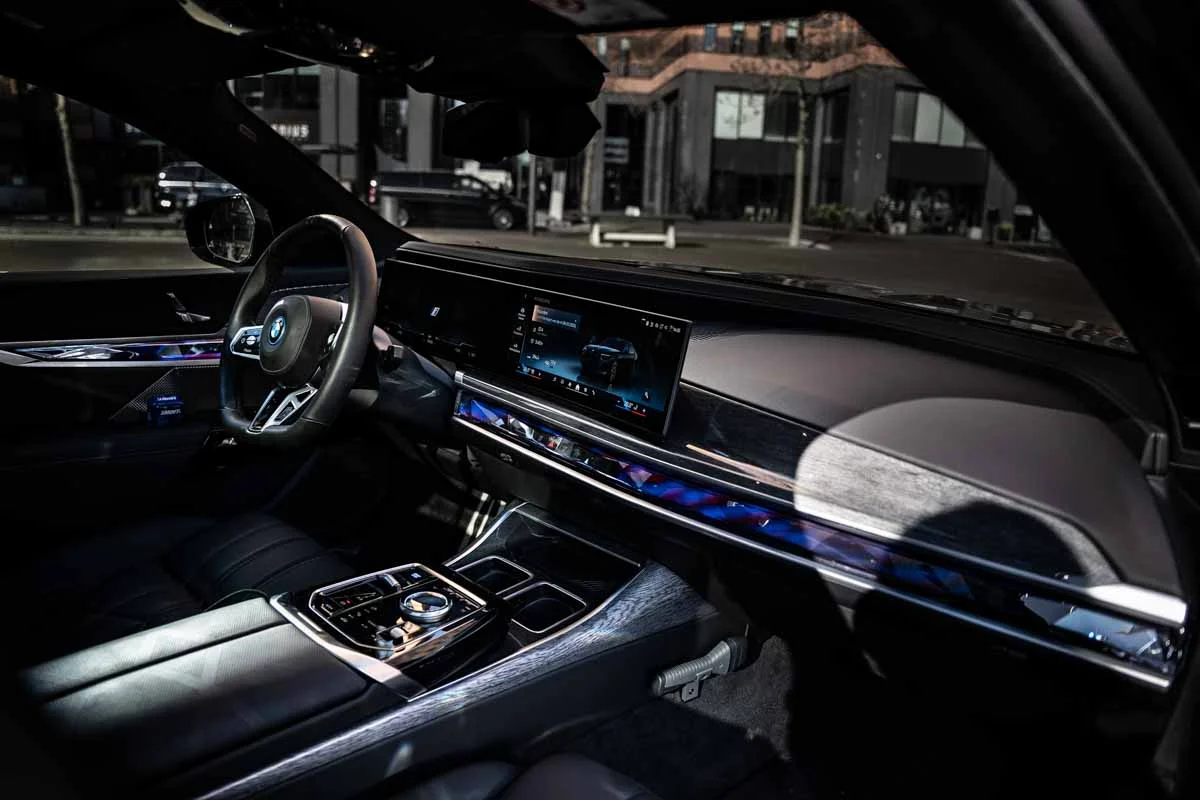
Electric cars arrived in chauffeur fleets a few years later than the marketing suggested and are now, quietly, doing a large share of the work. The BMW i7, the Mercedes EQS and the EQV are all built for exactly the kind of driving that chauffeur service consists of, and the reasons are more interesting than the environmental headline.
Here is what actually changes when your transfer is electric, and where the honest limits still are.
What The Passenger Notices
Silence. Not “quieter”: a different category of quiet. No engine note, no vibration through the floor at idle, no shift when the car pulls away. The practical effect is that a phone call from the rear seat sounds like a call from a room, and a two-hour journey is measurably less tiring.
This is the single largest passenger-side benefit, and it is the one nobody puts on a brochure because it is hard to photograph.
Smoothness. No gearbox means no shifts. Acceleration is continuous, which is precisely what you want when someone in the back is reading or holding a cup of coffee. Driven properly, and chauffeur work is about driving properly, an EV is easier to be a passenger in than any combustion equivalent.
The rear compartment itself. The i7 and EQS are both engineered as flagship saloons first and electric second. The rear seats, isolation and rear-seat controls are of a piece with a long-wheelbase S-Class, not a compromise on it.
What The Operator Deals With
The complications all sit on our side of the arrangement, which is where they should be.
Range planning. Official WLTP figures for the current i7 and EQS run to around 600 kilometres and beyond. Nobody in the business plans on those numbers. Sustained motorway speed, cold weather, a heated cabin and a full car all take their share, and roughly seventy per cent of the official figure is the sensible working assumption for a winter motorway run.
That is still 400-plus kilometres. Amsterdam to Düsseldorf, Brussels, Antwerp, Cologne, Rotterdam, The Hague and everything inside the Netherlands is comfortably within a single charge.
Charging on long runs. Amsterdam to Frankfurt, Berlin or Paris will involve a stop. Both cars accept high-power DC charging in the region of 200 kW, so a stop is fifteen to twenty-five minutes rather than an hour, and the Dutch and German motorway networks are unusually well provided with high-power chargers.
The important part is that the stop is planned rather than discovered. It goes into the schedule at quoting stage, near a service area a passenger would not object to, and typically coincides with a break the passenger wanted anyway. An operator who has not mentioned charging on a 600-kilometre EV quote has not thought about it.
Winter. Cold weather reduces range and slows charging. This is a genuine limitation, not a rounding error, and it is a reason a specific long January transfer might be better served by a combustion car. We will say so.
Low-Emission Zones, And Where This Is Heading
The regulatory direction across Europe is one-way. Cities have been tightening access for combustion vehicles for years, Germany’s Umweltzonen, France’s Crit’Air scheme, London’s ULEZ, and the newer generation of restrictions goes further, towards zero-emission zones rather than merely low-emission ones.
The Netherlands has been among the more aggressive markets here, with Dutch cities introducing zero-emission zones for commercial traffic on a published timetable.
For a chauffeur fleet this is not a compliance headache to be solved later; it is a reason to have made the transition already. For a client, it means an electric booking is the one least likely to be affected by an access rule that changes between now and the journey.
The Corporate Reporting Case
For a growing number of clients, the reason for booking an EV is not preference. It is that somebody has to report the number.
Companies with sustainability reporting obligations increasingly need per-journey emissions data rather than a general assurance that the supplier has a green fleet. That is a documentation requirement, and it has to be built into the account rather than reconstructed from invoices at year end.
If this applies to you, raise it when the corporate account is opened. It affects how bookings are recorded from the first journey, and retrofitting it is considerably more painful than setting it up.
The same point applies to event and delegation work, where a client’s own reporting may need the ground transport figures alongside everything else.
The Cars
BMW i7. The electric 7 Series, and a genuine flagship rather than an electric variant of something lesser. Rear-seat comfort and isolation are the point of the car, and it makes an unusually good long-distance chauffeur vehicle.
Mercedes EQS. Built on a dedicated electric platform, with the longest official range figures in this group and a rear compartment aimed squarely at chauffeur use.
Mercedes EQV. The electric V-Class, with the same body and seating layouts. Range is shorter than the saloons, which makes it a strong city and regional vehicle and a more considered choice for long cross-border work.
All three do the same job as their combustion equivalents on the routes that make up the bulk of chauffeur work: airport transfers, hourly hire across a day of meetings, and regional journeys across the Netherlands and into Belgium and Germany.
When A Combustion Car Is Still The Right Answer
We would rather say this than have you find out.
- Very long single-day runs in winter, where two charging stops would be required and the schedule cannot absorb them.
- Remote destinations where high-power charging is genuinely sparse.
- Unpredictable itineraries with no fixed end point and a possibility of a long unplanned leg late in the day.
- When you have asked for a Maybach, which is a different request entirely.
For everything else, and everything else is most bookings, an electric car is at worst equivalent and usually better from the rear seat.
What To Ask When Booking An EV Transfer
- Is a charging stop planned, and where? For any journey over about 400 kilometres.
- What is the contingency if charging is unavailable?
- Can you supply per-journey emissions data? If you need it for reporting.
- Is the price affected by the charging stop? It should not be. Ours is fixed at booking either way.
Frequently Asked Questions
Is an electric car actually better for chauffeur work?
For the passenger, usually yes. There is no engine noise and no gearshift, which makes a phone call from the rear seat noticeably clearer and a long journey less tiring. The trade-off is entirely on the operator’s side, range planning and charging, which is where it belongs.
What is the real range of a BMW i7 or Mercedes EQS?
Official WLTP figures for these cars run to around 600 kilometres and beyond. Plan on materially less in practice: sustained motorway speed, cold weather and a full car all reduce it, and a realistic working figure is roughly seventy per cent of the official number.
Will an electric transfer need a charging stop?
Not for city work, airport runs or most regional journeys. On a long cross-border run, Amsterdam to Frankfurt, say, a stop is likely, and it should appear in the plan before the day rather than as a surprise. A fifteen to twenty-five minute stop at a high-power charger covers most of what a journey like that needs.
Can you provide emissions data for corporate reporting?
Yes. Companies with reporting obligations increasingly need per-journey figures rather than a general claim about a green fleet. Ask for it when the account is set up, so the data is captured from the start rather than reconstructed later.
Do electric cars have any advantage in city centres?
Yes, and it is growing. European cities are steadily tightening low-emission and zero-emission zones, and electric vehicles retain access where combustion vehicles are restricted or charged. The Netherlands has been among the more aggressive markets on urban zero-emission zones.
The Short Version
An electric chauffeur car is quieter, smoother and better to work in than its combustion equivalent, and the complications, range, charging, winter, belong to the operator rather than to you. Plan on about seventy per cent of the official range, expect a planned stop on anything over 400 kilometres, and ask for emissions data if somebody in your organisation has to report it. Ask for the i7 or the EQS when you book, and we will plan the route around it.
More from the Journal
Chauffeur Service in Haarlem: The Quiet Side of Amsterdam
Chauffeur service in Haarlem: Schiphol transfers, the North Sea beaches at Zandvoort, bulb-field season and a medieval centre cars cannot enter.
How to Become a Chauffeur: Licences, Skills and Getting Hired
How to become a chauffeur or private driver: the Dutch taxi driver card explained, licensing across Europe, what operators actually screen for, and the real job.

Wedding Transportation: Moving the Guests, Not Just the Couple
A practical wedding transportation guide: shuttle loops, vehicle mix, timings that hold, late-night returns and the contingencies that save the evening.