
Mercedes S-Class Chauffeur Service: Why It Became the Default
Why the Mercedes S-Class is the standard chauffeur car: the long wheelbase, the chauffeur package, rear-axle steering, and when a Maybach or E-Class fits better.
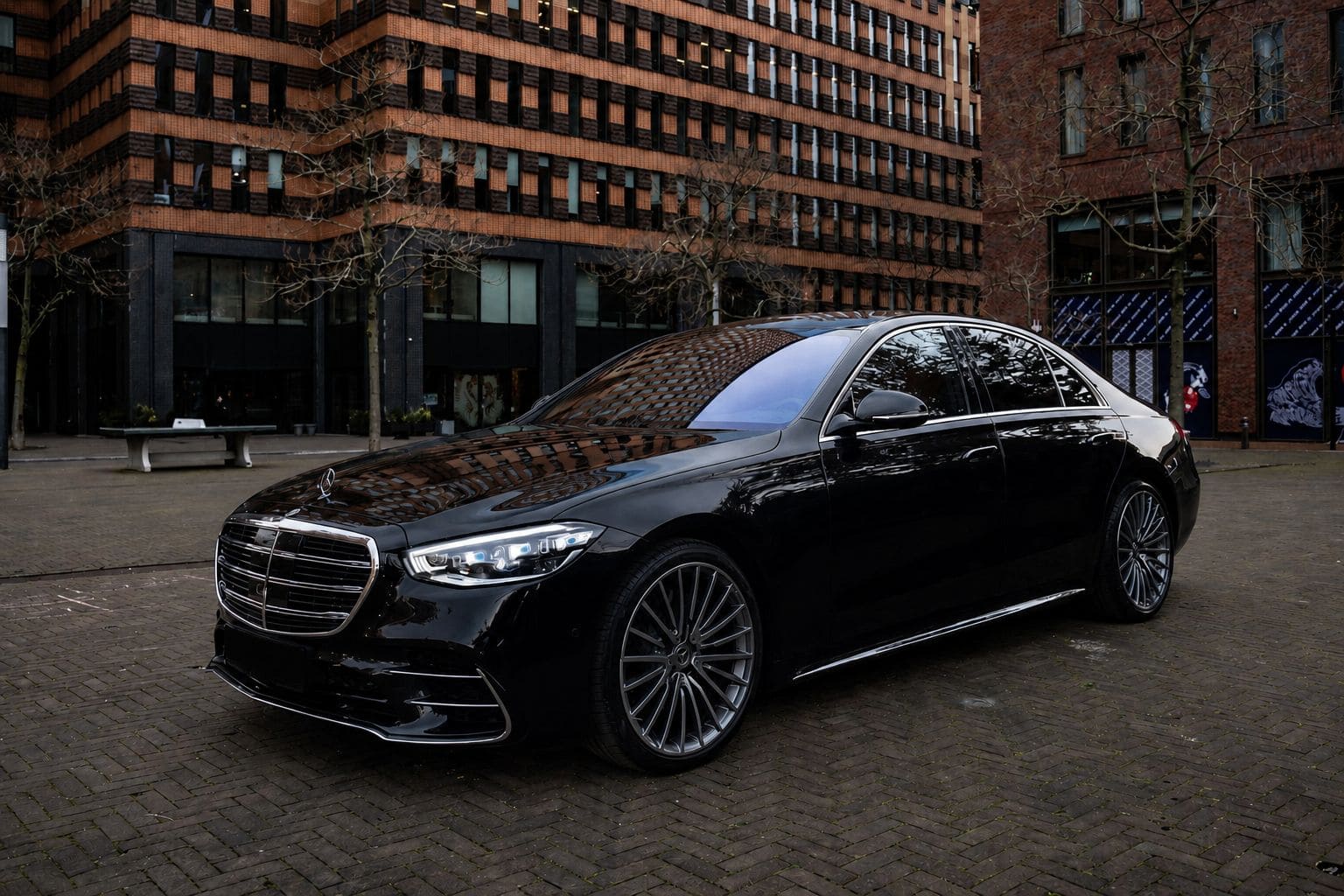
Ask any chauffeur company in Europe what they run, and the answer starts with the same car. The Mercedes S-Class has been the default chauffeur vehicle for decades, and unlike most defaults it is not an accident of habit. The car is engineered for the job in a way that its rivals mostly are not.
This is a guide to what that actually means in the rear seat, what the “chauffeur package” is, and the three occasions when something else is the better booking.
Built Around The Back Seat
Most executive saloons are designed for a driver who owns them. The S-Class, particularly in long-wheelbase form, is designed for a passenger who does not.
The extra length in the long-wheelbase car goes almost entirely behind the B-pillar. That produces rear legroom that changes what is possible on a journey: a laptop opens fully, a document can be read at a sensible distance, and a tall passenger can sit without negotiating with the seat in front.
Three other design decisions matter more than the specification sheet suggests.
Ride quality. Air suspension and, in higher specifications, actively controlled damping. The measurable outcome is not comfort in the abstract: it is whether you can read on a motorway without your eyes fighting the car.
Isolation. Acoustic glazing and serious sound insulation. In practice this means a phone call from the rear seat sounds like a call from an office rather than a call from a car, which for many passengers is the entire justification for the booking.
Rear-axle steering. The current generation steers the rear wheels by up to ten degrees at low speed, which shrinks the turning circle substantially. That sounds like a technicality until a car this long has to turn in an Amsterdam canal street or a Paris hotel courtyard, at which point it is the difference between a smooth arrival and a five-point turn in front of the entrance.
The Chauffeur Package, Explained
If you have travelled in an S-Class and found the rear seat astonishing, and travelled in another and found it merely very good, this is usually why.
Mercedes offers a factory configuration built around the rear passenger sitting behind the front passenger seat. That front seat slides forward, its backrest folds away, and a footrest deploys, producing an extended, near-reclined position that would be impossible in a normal four-seat layout.
Two things follow from this.
First, it is a one-passenger luxury. The seat behind the driver stays conventional. A chauffeur-package car carrying two rear passengers gives one of them the full experience and the other a very good ordinary seat.
Second, not every S-Class has it. It is an option, not a standard fitment, and it is more common in cars specified for chauffeur fleets than in privately bought ones. If the reclining rear seat is why you are booking, say so at the time of booking, because it is a genuine difference between two cars that carry the same badge.
S-Class, E-Class, Maybach: Choosing Sensibly
The honest version of this comparison is that most journeys do not need the most expensive answer.
| Situation | Sensible choice |
|---|---|
| Schiphol to an Amsterdam meeting, one or two passengers | S-Class |
| Routine daily executive travel on a controlled budget | E-Class |
| Two hours of city-to-city driving with work to do | S-Class or Maybach |
| An arrival that will be photographed | Maybach |
| Wedding or milestone occasion | Maybach |
| Three or more passengers together | V-Class |
| Corporate account prioritising emissions reporting | EQS or i7 |
The E-Class is a serious car and, for a short transfer with a single passenger and a briefcase, is often indistinguishable in the ways that matter. Operators who suggest it are not fobbing you off; they are pricing the job honestly.
The Maybach takes the S-Class platform, stretches it further, gives the additional length to the rear again, and adds materials, isolation and reclining rear seats as standard. Our Maybach guide covers where that premium earns itself and where it does not.
The V-Class is not a downgrade for groups: it is simply the correct vehicle once you pass two passengers, as covered in our V-Class guide.
The Practical Reasons Operators Standardise On It
Beyond the rear seat, three unglamorous factors keep the S-Class as the fleet default across Europe.
Availability of a replacement. If a car develops a fault the morning of a transfer, another S-Class is findable in almost any European city. That is not true of more exotic choices, and it is the difference between a swapped vehicle and a cancelled booking.
Service and parts. The dealer network is everywhere, which matters on long cross-border work.
Client expectation. For corporate travel, the S-Class is the vehicle that generates no comment in either direction. Nobody queries the expense line, and nobody is disappointed at the kerb. There is real value in a car that is simply correct.
Where It Shows Up In Our Work
The S-Class does the bulk of ordinary executive work: airport transfers at Schiphol, Eindhoven, Rotterdam The Hague, Brussels and Düsseldorf; hourly hire across a day of meetings; and city-to-city runs where the rear seat has to function as an office for several hours.
It is also the default for corporate accounts, where the requirement is consistency: the same category of vehicle every time, the same standard of driver, and an invoice that does not need explaining.
Whichever car you book, the commercial arrangement does not change. The price is agreed at booking and does not move for traffic, and flight tracking is included on every airport arrival.
Frequently Asked Questions
Why is the S-Class the standard chauffeur car?
Because it was designed for the job. The long-wheelbase version gives its extra length almost entirely to the rear compartment, the ride quality suits people trying to read rather than drive, and the car is common enough across Europe that servicing, parts and replacement vehicles are never a problem. It is the default because it is the safe choice, not because it is the flashiest.
What is the Mercedes chauffeur package?
It is a factory option built around the rear passenger behind the front passenger seat: that front seat moves forward and its backrest folds, with a footrest, so the rear occupant gets a near-flat extended position. It is why some S-Class cars have a strikingly reclined rear seat and others do not. Ask which configuration you are getting if it matters to you.
What is the difference between an S-Class and a Maybach?
The Maybach is built on the S-Class but stretched further, with the extra length again given to the rear, plus higher-grade materials, more rear isolation and reclining rear seating as standard. For a 25-minute airport run the difference is largely aesthetic. For two hours of working in transit, or an arrival that will be noticed, it is not.
Is a short-wheelbase S-Class fine for a chauffeur booking?
It is a good car, but it is the wrong one. The whole point of a chauffeur S-Class is the rear legroom of the long-wheelbase version. If an operator cannot tell you which one is coming, that is worth knowing before you book.
How many passengers does an S-Class take?
Three in the rear at a squeeze, but chauffeur configurations are built around two, and with the chauffeur package the practical figure is two. For three or more travelling together, a V-Class is the better vehicle and usually the cheaper one.
The Short Version
The S-Class is the default chauffeur car because it was built to be one: the long wheelbase puts the space where the passenger is, the isolation makes the rear seat usable as an office, and the rear-axle steering makes a very long car behave in city streets. Ask for the long-wheelbase version, ask whether it has the chauffeur package if the reclining seat matters, and take an E-Class without embarrassment when the journey is twenty minutes. Tell us the route and we will tell you which car it deserves.
More from the Journal
Chauffeur Service in Haarlem: The Quiet Side of Amsterdam
Chauffeur service in Haarlem: Schiphol transfers, the North Sea beaches at Zandvoort, bulb-field season and a medieval centre cars cannot enter.
How to Become a Chauffeur: Licences, Skills and Getting Hired
How to become a chauffeur or private driver: the Dutch taxi driver card explained, licensing across Europe, what operators actually screen for, and the real job.

Wedding Transportation: Moving the Guests, Not Just the Couple
A practical wedding transportation guide: shuttle loops, vehicle mix, timings that hold, late-night returns and the contingencies that save the evening.