
Amsterdam to Munich: Flight, Train or Chauffeur
Amsterdam to Munich is about 820 km, roughly 8 hours of driving. When flying wins, when the car makes sense, and how a chauffeured long-distance day works.
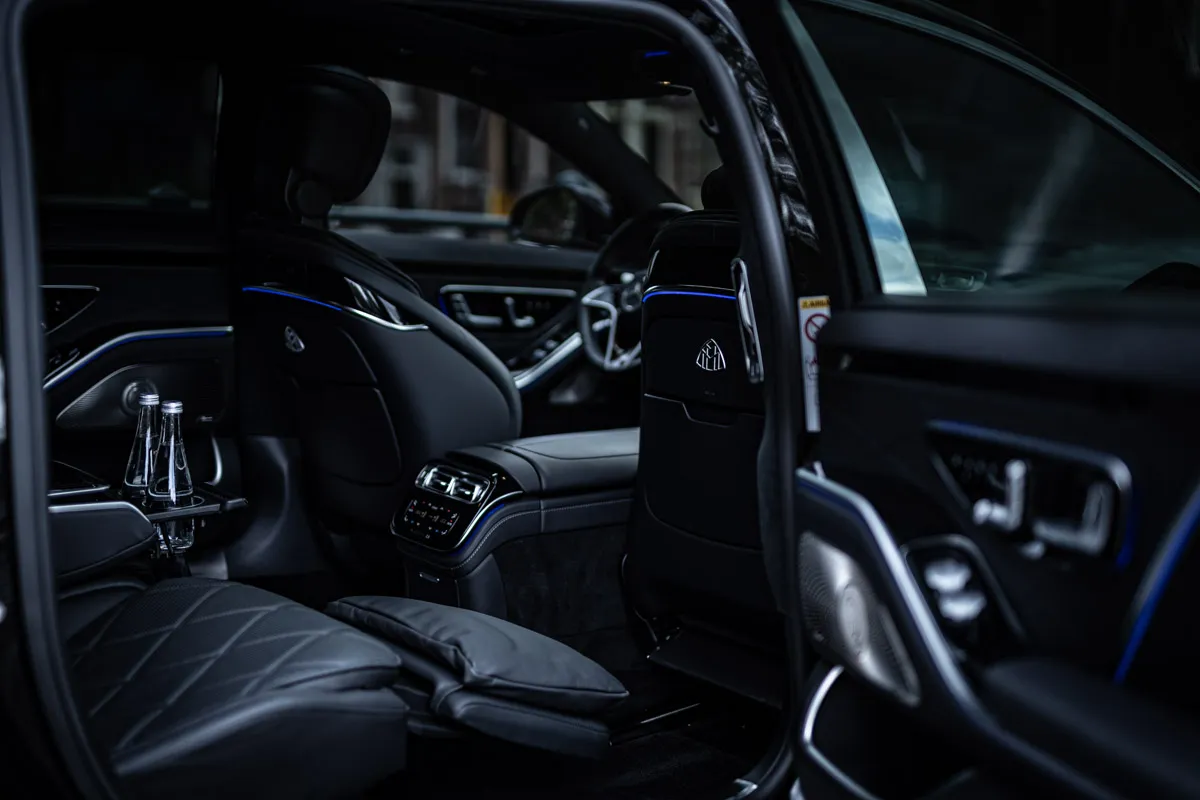
Amsterdam to Munich is roughly 820 kilometres by road, about 8 hours of driving in normal traffic before breaks, south-east through Germany past Cologne, Frankfurt and Nuremberg. A direct flight spends around an hour and a quarter in the air, which is why most single travellers fly, and the car is a deliberate choice rather than the default.
The road still has a clear case for some trips. Families heading for the Alps with skis and luggage, teams travelling to Messe München with their material, travellers who prefer not to fly and anyone carrying something they would rather not check in all have good reasons to take the road. This guide gives the honest comparison, then the route, the timing and what a chauffeured long-distance day looks like.
Amsterdam to Munich at a Glance
On time alone, flying wins this route clearly. The table shows the realistic door-to-door picture.
| Option | Time in transit | Realistic door to door | Best for |
|---|---|---|---|
| Flight, Schiphol to Munich | About 1 hour 15 in the air | Roughly 5 to 6 hours | One or two travellers on a schedule |
| Train | Seven hours or more by day | Most of a day | Travellers who prefer rail and can work on board |
| Self-drive | About 8 hours, plus breaks | 9 to 10 hours | Drivers who want their own car in Bavaria |
| Private chauffeur | About 8 hours, plus breaks | 9 to 10 hours, all of it usable | Groups, ski luggage, valuables, travellers who do not fly |
Flying, the Train or the Car
Flying is the efficient answer for most single travellers, rail is a full day’s commitment, and the car earns its hours when the journey carries more than one person and a small bag.
When flying wins
Direct flights between Schiphol and Munich run frequently, and for one or two people with a meeting to reach, flying is the sensible choice. Allow for both airports, though. Munich Airport lies roughly 30 to 35 kilometres north-east of the city, about 40 to 45 minutes from the centre by road or S-Bahn, which is why the realistic door-to-door figure is five or six hours rather than the flight time. Our Munich Airport guide covers the terminals and the journey into town.
The train
By day, rail takes seven hours or more, depending on the connection, and night trains have also served this corridor. Timetables between the Netherlands and Bavaria change often, so check NS International or Deutsche Bahn for the current options before you plan around one.
When the car makes sense
The car loses on time and wins on what travels with you. The Mercedes-Benz V-Class carries seven people and seven cases, ski bags included, in one cabin. Instruments, samples, artwork and documents stay in the car from door to door instead of passing through security and a baggage hall. For a group of four to seven, one vehicle replaces a row of flight tickets and two taxi rides at each end. And the journey can include a meeting in Cologne or Frankfurt on the way, or carry on past Munich into the mountains.
There is a quieter argument too. Some clients choose eight hours on the road over a flight precisely because those hours belong to them: a rear cabin quiet enough for calls, no boarding gates and no queues. Our comparison of city-to-city travel in Europe sets out where that trade is worth making.
The Route: A12, A3 and A9
From Amsterdam the car heads south-east to Utrecht, then east past Arnhem on the A12, and crosses into Germany near Emmerich. The A3 then carries the journey south past Oberhausen and Cologne to the Frankfurt interchange, close to the halfway point, and on to Würzburg and Nuremberg, where the A9 takes over for the final run into Munich.
A few things about this road are worth knowing:
- No tolls. Germany has no general road toll for cars, and the Dutch section is free as well, so the route needs no vignette.
- The autobahn, realistically. Long stretches carry no general speed limit, with an advisory 130 km/h, but much of the network is signed for roadworks, junctions and urban approaches, and the Rhine-Ruhr corridor carries heavy freight traffic. The chauffeur plans on realistic averages, not on the reputation.
- The border. There is no fixed passport control between the Netherlands and Germany, but German police can check vehicles near the border, so carry a passport or ID card.
- The Umweltzone. Munich, like most sizeable German cities, operates a low emission zone that requires a green Umweltplakette on the windscreen. Professional fleets comply as a matter of course.
On the Dutch side, most motorways are limited to 100 km/h between 06:00 and 19:00, which is one more reason to leave Amsterdam early. Our guide to chauffeur service in Germany explains the German rules in more depth.
Airports along the way
Düsseldorf and Cologne Bonn airports both lie close to the A3, and Frankfurt Airport sits beside the Frankfurt interchange itself, before the road continues to Munich Airport north-east of the city. That gives a long drive natural fallback points, and it makes split itineraries easy: drive down with the luggage and fly home, or the other way round.
Rush Hour, Holidays and Fair Weeks
Both the clock and the calendar shape this journey. Amsterdam’s weekday peaks run from about 07:00 to 09:30 and 16:00 to 19:00, so a departure before 07:00 clears the A10 and the Dutch motorways before they fill, and puts the Ruhr and Cologne stretches behind you by late morning. Arriving in Munich after its late-afternoon peak, or before it, makes the last kilometres far easier than meeting it head on.
Holidays matter even more. The Dutch spring break in February and March sends waves of traffic towards the Alps, and the ski changeover weekends are the pressure points on routes through Germany. German states stagger their summer school holidays, which spreads the load but leaves a busy weekend somewhere on the network for much of the summer. Our guide to European holiday traffic lists the dates to plan around.
Munich has its own peaks. Oktoberfest runs from late September into early October, and the large fairs at Messe München, among them bauma and Expo Real, fill hotels and roads across the region. Book early if your dates touch any of them.
Pacing an Eight-Hour Drive
An eight-hour drive is planned, not improvised. SilverDrive runs this route in one of two ways.
One long day. An early start, planned breaks at quality service areas, and, where the schedule demands it, a second chauffeur who shares the driving so that nobody exceeds safe limits. You arrive in Munich in the late afternoon or early evening, with the day’s work done in the back of the car.
Two easier days. An overnight stop near Frankfurt, roughly halfway, turns the trip into two drives of about four hours each. It suits families, travellers who want an evening in a city on the way, and anyone who has to be at their best the morning after arrival.
Either way, the route, the breaks and any charging stops for an electric car are fixed before departure. Our guide to long-distance car service explains how these itineraries are put together.
What a Typical Booking Looks Like
A typical booking is one car and one screened, English-speaking chauffeur from your door in Amsterdam to your address in Munich, at a fixed price agreed before the journey, with no meter, no surge and no hidden fees.
The vehicle follows the party:
- One to three passengers: the Mercedes-Benz S-Class or the Mercedes-Maybach S-Class for the most comfortable long day, or the electric BMW i7, which is at its best on long journeys, with charging planned into the breaks.
- Families and ski groups of up to seven: the V-Class.
- Larger groups and teams: the 16-seat Sprinter VIP or the 52-seat Setra coach.
The car can drop you and return, or stay with you in Bavaria for meetings, the Messe or a week in the mountains. See our long-distance chauffeur service for multi-day bookings.
Arriving in Munich
Munich’s business and hospitality addresses cluster in a few districts. The Altstadt and Maximilianstraße hold the historic centre, the grand hotels and the flagship stores, with pedestrian zones that make the exact drop-off point matter. Schwabing and Maxvorstadt carry offices, universities and museums, Bogenhausen has consulates and quiet hotels east of the Isar, and Messe München sits in Riem on the eastern edge of the city.
From Munich, Salzburg is about an hour and a half by road, Innsbruck about two hours, and the Bavarian lakes and the castles are easy day trips, so the car often has a second life once you arrive. Our Munich city page covers chauffeur service in the city, and our Amsterdam to Frankfurt guide covers the first half of this journey as a trip in its own right.
Book Amsterdam to Munich
For one traveller with a meeting, fly. For a group, a family with skis, valuables, a stop on the way or a trip that continues into the Alps, Amsterdam to Munich by chauffeur turns a long journey into one planned day, or two, at a price fixed before you leave. Tell us the dates, the passengers and the luggage, and we will return a fixed price and a suggested plan. Book your journey or contact us to talk it through.
Frequently asked questions
How long is the drive from Amsterdam to Munich?
Around 8 hours of driving for roughly 820 kilometres, before breaks, in normal traffic. With proper stops, plan on 9 to 10 hours door to door. Roadworks on the A3 and heavy freight traffic through the Rhine-Ruhr region are the usual variables, which is why departure times are set around them rather than around the clock.
Is it better to fly or drive from Amsterdam to Munich?
For one or two people with a schedule, fly: door to door the trip takes roughly five to six hours, against nine or more by road. Driving makes sense for groups, ski luggage, valuables, travellers who prefer not to fly, and itineraries with stops in Cologne or Frankfurt or a continuation into the Alps.
Are there tolls on the drive from Amsterdam to Munich?
No. Neither the Netherlands nor Germany charges a general motorway toll for cars, and no vignette is needed for this route. That changes only if the journey continues into Austria or Switzerland, both of which require a motorway vignette. With SilverDrive, any such charges sit inside the fixed price.
Do I need a green sticker to drive into Munich?
If you drive yourself, yes: Munich operates an Umweltzone, and cars entering it must display a green Umweltplakette on the windscreen, foreign-registered cars included. Professional fleets comply as a matter of course, so on a chauffeured journey the sticker is not something you need to think about.
Can the drive from Amsterdam to Munich be done in one day?
Yes, as one long day with planned breaks, and with a second chauffeur when the schedule calls for it, so that nobody drives beyond safe limits. The alternative is two relaxed days with an overnight stop near Frankfurt, roughly halfway, which suits families and anyone who wants to arrive in Munich fresh.
Can the chauffeur continue from Munich to the Alps or Salzburg?
Yes. Salzburg lies roughly 90 minutes beyond Munich by road, Innsbruck roughly two hours, and lakes such as Starnberg are under an hour away. The same chauffeur and car can stay with you for the whole trip, quoted as one fixed price before you leave Amsterdam.
What does a chauffeur from Amsterdam to Munich cost?
It depends on the vehicle, whether the trip is one-way or a return, whether it runs over one day or two, and how many days the car stays with you. SilverDrive quotes the whole itinerary as one fixed price at booking, with no meter and nothing added for traffic or roadworks.
More from the Journal

Barcelona Car Service: BCN Airport, Cruise Port and City
Barcelona car service explained: BCN airport pickups, cruise port transfers at Moll Adossat, city hours and day trips, and how to book a car with driver well.
Private Chauffeur: What It Is, What It Costs, How to Choose
A private chauffeur explained: the four ways to book one, what actually sets the price, the brief to send and how to choose an operator anywhere in Europe.

Places That Pay You to Move There: What Is Real in 2026
Places that pay you to move there in 2026, checked against official sources: Irish islands, Sardinia, Sicily, rural Spain, Tulsa and West Virginia.