
Executive Car Service, Driver and Transfer: How to Choose
What an executive car service is, how it differs from an executive taxi, what your executive driver handles, and four tests to apply before booking a transfer.
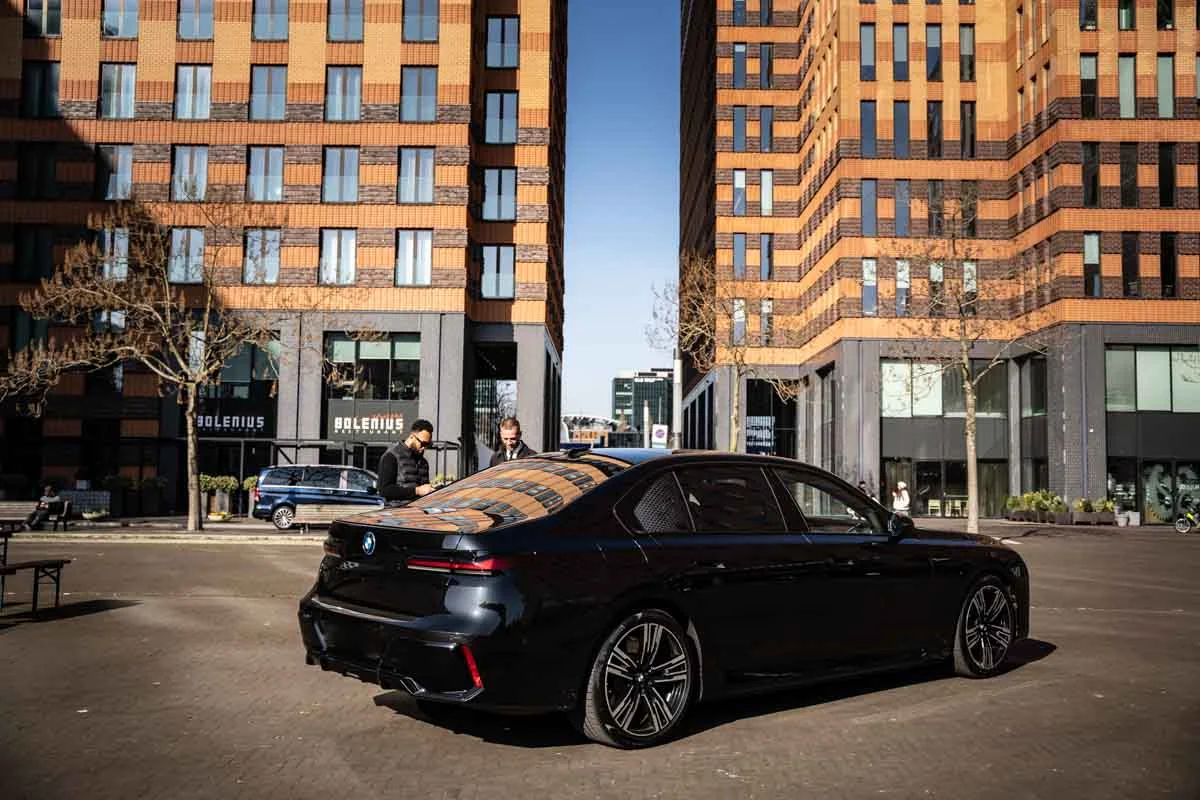
An executive car service is pre-booked ground transport in a premium vehicle, typically a Mercedes-Benz E-Class or S-Class, driven by a professional chauffeur and priced as a fixed figure agreed before the journey. You arrange it the way you arrange a flight: the car, the executive driver and the price are all settled days before anyone gets in, so an executive transfer to an airport or a client meeting arrives at the time it promised. It is what companies book when a taxi is too unpredictable and a limousine is too much: quiet, unmarked, on time, and accountable.
The category answers to several names. Americans say black car service; British firms advertise executive chauffeur services, or an executive taxi; corporate travel desks file the same journeys under corporate car service. They all describe one product, and the label on the website matters far less than how the operator actually runs. This guide defines the category, explains what the chauffeur is really responsible for, and gives you four tests that separate the serious operators from the rest.
Is an Executive Taxi the Same as an Executive Car Service?
Mostly yes, though the word taxi is doing two jobs at once. Some firms use executive taxi to describe their premium tier: a newer car and a smarter driver, but still metered and still dispatched at short notice. Others use the phrase simply because it is what their customers type into a search box, while the product behind it is a pre-booked car at an agreed price.
The distinction that matters is the booking, not the noun. Executive rides are arranged in advance against a named passenger, a confirmed vehicle class and a number that does not move afterwards. If the fare is decided by a meter once you have already arrived, you are buying a taxi with better upholstery.
Executive Car Service vs Taxi, Ride-Hail and Limousine
The differences are structural, not cosmetic. A taxi sells availability: it is there when you flag it, and the meter decides the price. Ride-hail sells convenience at a floating price: quick to summon, but the driver is whoever accepts, the car is whatever they drive, and surge pricing means the fare is set by demand at that moment. A limousine service sells occasion (stretched vehicles, weddings, proms), which is precisely the impression most business travellers want to avoid.
An executive car service sells certainty. The vehicle class is confirmed at booking, the chauffeur is trained and screened, the price is fixed in advance, and there is a company answerable for the whole arrangement.
| Taxi | Ride-hail | Executive car service | |
|---|---|---|---|
| Price | Meter | Floating, surge-priced | Fixed at booking |
| Vehicle | Whatever arrives | Whatever the driver owns | Confirmed class, maintained fleet |
| Driver | Licensed driver | Gig driver | Screened professional chauffeur |
| Booking | On demand | On demand | Pre-booked, schedule-aware |
| Journey brief | None | None | Route, stops and notes read in advance |
| Flight delay | Your problem | Your problem | Tracked; pickup moves with the flight |
| Accountability | Dispatcher, maybe | An app form | A company you can call |
None of this makes ride-hail useless: for a spontaneous short hop across town it is often the sensible choice. The executive car earns its price when the journey has consequences: a flight to make, a client to receive, a board meeting that cannot start without you.
What an Executive Driver Actually Does
The fare buys a person, not only a vehicle, and most of that person’s work happens before you see the car. An executive driver reads the booking the day before: the route and its known pinch points, the buffer the time of day demands, whether the passenger is landing rather than leaving, and any note you left about luggage, a wheelchair, a child seat or a second pickup on the way. A pickup that looks effortless at 05:40 was decided the previous afternoon.
On the day the job is judgement. The chauffeur watches the traffic and quietly chooses another road rather than announcing the problem, handles the cases, holds the door, and then reads the cabin: conversation if you want it, silence and a stable phone signal if you are working, and nothing repeated afterwards. When the meeting overruns or the flight lands two hours late, an executive driver waits and reworks the rest of the day instead of cancelling the booking. That is the difference between hiring transport and hiring a professional.
The Four Tests Before You Book
Websites in this market look alike. These four questions reveal what sits behind them, and any operator worth using answers all four without hesitation.
1. Is the price fixed before the car moves?
The quote should be a single figure agreed at booking, covering the route, waiting within a standard window, and on cross-border work the tolls too. If the answer involves a meter, an estimate, or fine print about traffic supplements, the real price is unknown until the journey ends. SilverDrive quotes one number and it holds; how that works is on our prices page.
2. Does the operator own its fleet?
Much of the industry is brokerage: a polished booking site that passes your job to a local subcontractor you have never vetted. That model works until it doesn’t: a different car than promised, a driver who knows nothing of your booking notes. An operator with an owned fleet and its own chauffeurs controls the standard directly. Ask the question plainly; the hesitation is the answer.
3. Are they genuinely available 24/7?
Executive travel does not keep office hours. The test is not whether the website says 24/7 but whether a human confirms a 4:30 pickup for a 6:00 departure, and whether someone answers the phone when a flight lands at 1:00. An answering service that opens at nine is a nine-to-five company.
4. Who is accountable when something goes wrong?
Flights divert. Meetings overrun. The measure of an operator is not that nothing ever slips but that someone owns the problem: a company you can reach, a chauffeur already rebooked to the new arrival time, a policy stated before the trip rather than negotiated during it. This is where flight tracking on airport transfers stops being a feature and becomes the whole point.
E-Class or S-Class: Matching the Car to the Journey
Most executive work needs an E-Class, and the honest operators say so. It is a genuinely comfortable four-seat saloon, entirely appropriate for airport runs, daily transfers and routine client work.
The S-Class earns its premium in three situations: journeys long enough that the rear seat becomes a working office, passengers whose seniority makes the vehicle part of the message, and arrivals that will be noticed. For groups of three or more, neither saloon is right: the V-Class seats seven with room for luggage, and delegations combine vehicle classes as needed through our corporate transport service.
Above the S-Class sits the Mercedes-Maybach, which is a different proposition again: the rear cabin as the destination. When that is worth booking, and when it is not, is covered in our guide to Maybach chauffeur service.
Electric deserves a mention: the EQS and BMW i7 deliver the full executive standard with zero tailpipe emissions, which increasingly matters to companies reporting on travel. Ask for them by name when booking.
Three Shapes of Executive Transfer
Almost every booking takes one of three forms, and naming yours before you enquire gets you a cleaner quote.
The airport run is the most common: one pickup, one drop, a flight number attached so the arrival is watched rather than guessed. It is also where the gap between an executive transfer and a cab queue is widest, because a delayed landing costs you nothing when the operator is already tracking it.
The city to city leg is the second: Amsterdam to Brussels, Rotterdam to Cologne, a route where the train is awkward and the short flight eats the morning in security queues. For distances of a few hours, driving often beats flying once you count the door-to-door time and the work you can do in the back.
The third is the day itself rather than a journey: a car and chauffeur held for a block of hours while you move between meetings. This is the format for investor days and roadshow transportation, where the schedule will change twice before lunch and rebooking single trips each time would be absurd.
What an Executive Car Service Costs
There is no universal rate card, and be wary of any that claims otherwise. Price follows distance or duration, vehicle class, timing, and how many vehicles the job needs. Two structures dominate: point-to-point transfers, priced per journey, and hourly hire, where the car and executive chauffeur stay with you (the better format for fluid, multi-stop days).
What you can control is the shape of the deal. Insist on the fixed figure upfront and the comparison between operators becomes honest, because you are comparing real numbers rather than optimistic estimates that grow in traffic.
Frequently Asked Questions
What is an executive car service?
Pre-booked, professionally driven ground transport in a premium saloon or MPV, priced as a fixed figure agreed before the journey. It differs from a taxi or ride-hail in that the driver is a trained chauffeur, the vehicle is confirmed in advance, and the arrangement is accountable to a company rather than an app.
What is an executive taxi?
Usually the same product under a different name: a premium car with a professional chauffeur, arranged ahead of time at a price agreed before you travel. Some taxi firms also use the term for their smartest cars, which are still metered and still dispatched at short notice. Ask whether the price is fixed at booking and whether the vehicle class is confirmed, and the difference becomes obvious.
Is a black car service the same as an executive car service?
Essentially yes. Black car service is the American term for the same product: an unmarked premium vehicle, a professional driver and a pre-agreed price. In Europe the same service is usually called an executive car service or chauffeur service. The label matters less than whether the operator passes the four tests.
What is the difference between a chauffeur and a driver?
Training and scope. A driver operates the vehicle. A chauffeur is screened and trained to manage the whole journey: route planning, timing buffers, luggage, meet-and-greet, discretion, and adjusting to changes without being asked. The word signals a standard of service, not just a person holding a licence.
Can I book an executive driver for a whole day?
Yes. Hourly hire keeps the car and the chauffeur with you rather than pricing each leg separately, which suits multi-stop days, investor roadshows and site visits. It is the better format whenever the timings are likely to move, because nothing has to be rebooked each time the plan changes.
How do I book an executive transfer from the airport?
Send the flight number along with the booking. The arrival is then tracked, so the pickup moves with the aircraft rather than with the timetable you booked against, and the chauffeur meets you in the terminal. For departures, give the flight time and let the operator work backwards to a pickup that holds even in morning traffic.
Should I book an E-Class or an S-Class?
Book the E-Class for routine transfers and airport runs. It is a genuinely comfortable executive car. Book the S-Class when the journey is longer, when you will work substantially en route, or when the arrival itself carries weight. Three or more passengers are better served by a V-Class.
How far in advance should I book an executive car?
For a standard transfer, a day or two ahead is usually comfortable, and SilverDrive takes bookings 24/7. Book further ahead for early-morning airport departures, multi-vehicle days, event dates, and demand peaks. Booking earlier never costs more, because the price is fixed either way.
Put Us to the Test
SilverDrive answers the four questions plainly: fixed prices agreed at booking, an owned Mercedes-Benz and BMW fleet, genuine 24/7 availability, and a 4.7/5 rating earned by owning problems rather than passing them on. Founded in Amsterdam by Joshua Faerber, we run executive chauffeur service across the Netherlands and Europe. Send us a route and compare the number you get back.
More from the Journal
Chauffeur Service in Haarlem: The Quiet Side of Amsterdam
Chauffeur service in Haarlem: Schiphol transfers, the North Sea beaches at Zandvoort, bulb-field season and a medieval centre cars cannot enter.
How to Become a Chauffeur: Licences, Skills and Getting Hired
How to become a chauffeur or private driver: the Dutch taxi driver card explained, licensing across Europe, what operators actually screen for, and the real job.

Wedding Transportation: Moving the Guests, Not Just the Couple
A practical wedding transportation guide: shuttle loops, vehicle mix, timings that hold, late-night returns and the contingencies that save the evening.